
It's Saturday Night Wednesday Afternoon Live!
“If I seem unduly clear to you, you must have misunderstood what I said.”
Alan Greenspan
Former Fed Chairman
(1987 – 2006)
In mid-September, the Federal Reserve (“the Fed”) raised its short-term interest rate target (“the Fed Funds Rate”) by a quarter of a percentage point, its first increase since July 2023. Historically, a policy shift of that kind could move markets sharply. This time, the decision itself, having been widely anticipated, was something of a non-event. What did move stocks was the Fed’s accompanying signal that further increases are likely before year-end. Equities, modestly higher ahead of the announcement, retreated during the afternoon press conference. That distinction between the decision and the guidance surrounding it reflects a more subtle change. Fed meetings, once the market’s equivalent of dramatic live television, have become far more predictable, and the surprises, when they come, now tend to lie in what the Fed signals on meeting day rather than in what it does.
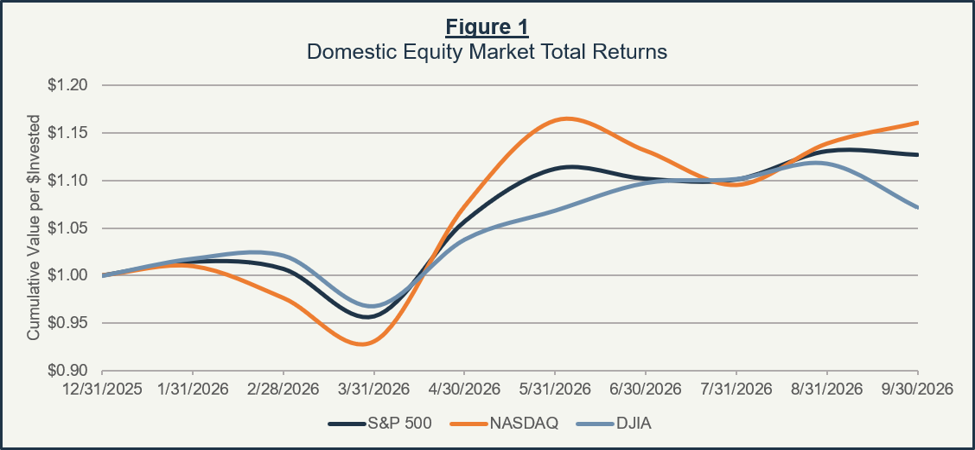
The rate decision was one of several crosscurrents in a mixed third quarter. Continued conflict in the Middle East, elevated fuel prices, and shifting sentiment toward AI stocks weighed on markets throughout the summer, with the S&P 500 and Nasdaq posting modest gains of 2.3% and 2.6%, respectively, while the Dow declined 2.3%.
The Fed’s principal objectives, as set by Congress, are to promote maximum employment and stable prices (i.e., keeping inflation in check), commonly referred to as its “dual mandate.” Changes to monetary policy—including but not limited to the target Fed Funds Rate—are determined by the 12-member Federal Open Market Committee (FOMC), which is composed of the Fed’s seven-member Board of Governors (including the Fed Chair) and the presidents of five of the 12 Federal Reserve Banks.[1] The FOMC meets eight times a year, with each two-day meeting beginning on a Tuesday and concluding Wednesday afternoon, when the Fed Chair details the Committee’s deliberations and any resulting policy changes at a press conference.
In the past, the outcome of those meetings could take investors by surprise. Such sessions were commonly known as “live meetings”: the FOMC’s decision was uncertain going in, and markets reacted in real time as it was announced, in effect on live television. Unlike Saturday Night Live, whose cast performs a full dress rehearsal before a studio audience hours before airtime, the Fed had no such opportunity to gauge the reaction in advance.
However, more recent decisions, including September’s increase, have generally been anticipated, leaving less for markets to react to when the announcement actually arrives. This may have been due in part to former Fed Chair Jerome Powell’s practice of “telegraphing” the Fed’s intentions in advance (to the extent practicable), which limited the potential for surprise and allowed the Fed to gauge the market’s likely response. Additionally, the growth of the Fed Funds Futures market has given investors a far clearer view of where rates are headed, as well as a means of hedging against unexpected moves.
Futures contracts may be thought of, in simple terms, as wagers on the future price of a commodity or, increasingly, on the outcome of an event. Fed Funds Futures, traded on the Chicago Mercantile Exchange (CME), allow participants to take positions on whether the Fed will raise or lower rates at upcoming meetings, from which a market-implied probability of each outcome can be derived. As of this writing, markets assign a ~73% chance of no change to the Fed Funds Rate at the October meeting, but a ~90% cumulative chance of a hike by the December meeting (the last of the year). Most participants anticipate a single quarter-point (25 basis points) increase, while a minority expect two, or half a percentage point (50 basis points) in total.
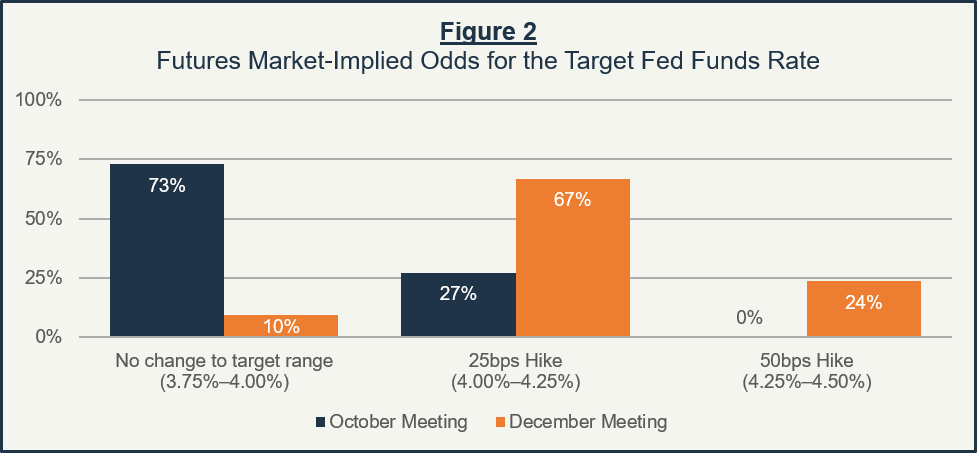
These probabilities can shift considerably on a daily, or even hourly, basis. Earlier this year, futures markets were pricing in rate cuts for 2026. But by late summer, the debate had turned to whether the Fed would raise rates. Two further factors add to the uncertainty. Kevin Warsh, who succeeded Powell as Fed Chair in May, has been more reserved in his public remarks, offering less of the forward guidance on which investors had come to rely. In addition, the path of inflation, a principal driver of Fed policy, has become less certain.
Recent geopolitical conflict has been decidedly inflationary, largely through higher fuel prices and their trickle-down effects felt throughout the broader economy. Other factors, such as the influence of AI, are more difficult to assess. In the near term, AI is a significant inflationary force, driving up costs across the energy, utility, technology hardware, and infrastructure sectors. The wealth it has created through elevated compensation, equity grants, and stock appreciation is also supporting robust spending among higher-income households—despite pullbacks across larger swaths of consumers. Over time, however, many (including Fed Chair Warsh) expect AI to prove deflationary as it accelerates productivity and output while lowering operational costs across a multitude of industries.
The Fed’s future path may therefore depend on questions that cannot yet be answered with confidence, including how durable the current AI boom proves to be, and which of its effects ultimately prevails. With less guidance forthcoming from its Chair, the Fed may have forgone the closest thing it had to a dress rehearsal. Combined with an uncertain economic backdrop, that could restore some of the suspense to FOMC meetings, and with it, greater volatility around them. After several years of reruns, Wednesday afternoons may once again merit tuning in.

_________________________________________________________________________________________
1 Boston, New York, Philadelphia, Cleveland, Richmond (VA), Atlanta, Chicago, St. Louis, Minneapolis, Kansas City (MO), Dallas, and San Francisco. The New York Fed president is a permanent member of the FOMC, while all other banks rotate through. Source: https://www.cmegroup.com/trading/interest-rates/countdown-to-fomc.html